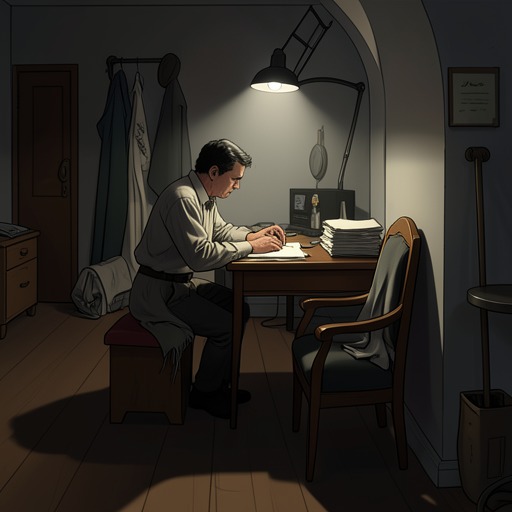
Éric Reinhardt’s post-novel creative crisis
L'Amour et les ForêtsÉric Reinhardt’s post-novel creative crisis is the collapse that follows an artistic triumph: after pouring his inner life into a book he once imagined as his final work, he finds himself depleted, unable to begin again, and haunted by the demand to surpass it. At his first meeting with Bénédicte Ombredanne, he describes this private exhaustion in extravagant, sometimes comic images, but also reveals that he has been crying alone each morning. Their exchange turns his creative blockage into the first basis of a relationship built on candid disclosure and attentive listening.
The crisis after success
Near the metro entrance created by Jean-Michel Othoniel, Bénédicte asks whether Éric Reinhardt has started another novel. He has not. After spending too long in the exhilaration of interviews and bookstore appearances, he has been postponing the return to work. The success of his latest book has not freed him from anxiety; it has sharpened it. He doubts that he can reproduce the conditions that produced the book’s extraordinary happiness, and fears that whatever comes next will be inferior.
The end of the book’s intense creative period feels to him like the end of an enchantment. The pressure is no longer simply the bitterness he experienced when his novels attracted little attention. Now he believes he is expected to do better. That expectation makes the accomplishment itself a source of distress: the more exceptional the book seems, the harder it is for him to imagine a worthy successor.
The book as a life wager
Reinhardt explains that the completed novel began in a state of profound sadness and a desire to end his life and his artistic career. He had imagined dying after publication, leaving behind a book into which he had put everything rather than continuing to disperse himself across years of smaller works. He describes gathering his notebooks, foundational sensations, valued thoughts, and intimate substance into a single work. The novel became, in his account, a last chance to make the definitive book he had long wanted to write.
As he worked, however, the original despair changed. He compares the writing to driving a red Porsche at 230 kilometres per hour, in contrast to his ordinary, slower work in a Renault Clio. The image captures both the recklessness and exhilaration he associates with the book: he took risks, pursued his ambitions at full speed, and increasingly wanted to live as the work advanced. The Porsche then becomes a rocket carrying him through the sky toward the stars. By the time he finishes the novel, he says, he no longer wants to die; he wants to enjoy what he has made.
That transformation does not last. After the book is complete, he feels returned to an even worse starting point, with no reserves left. He separates himself from the figure who wrote the novel between October 2004 and March 2007, describing that writer as someone who was not quite himself. The distinction suggests that the book’s extraordinary freedom came at the cost of exhausting the person expected to write what followed. His crisis is therefore not only a fear of failure but a rupture between the self that made the successful work and the depleted self who must continue.
Confession and response
Reinhardt delivers this account while Bénédicte trembles and waits for him to reach a hopeful conclusion. He recognizes that his description may sound catastrophic, and later acknowledges its emphatic, cartoon-like exaggerations and burlesque turns. Yet he insists that its underlying account is true. His theatrical manner does not cancel the distress it carries; it gives him a way to make that distress speakable during a first meeting.
Bénédicte answers that she is not worried about his ability to write again. She believes the author of the novel cannot simply have no creative provisions left, and suggests that he may need rest after such an experience. Her response does not demand that he immediately overcome the blockage. Instead, it offers him permission to recover his breath. Reinhardt thanks her and tells her that discussing his anxiety has helped. He also reveals that none of his close friends or family know how badly he feels, or that he cries every morning in his office. The conversation makes her one of the first people to whom he has disclosed the full extent of his post-book state.
The unwritten next novel
Even while unable to begin, Reinhardt can describe a possible next project. He imagines a quick, incisive book aimed directly at its readers, featuring a man in his thirties who lives reclusively with his mother and exchanges electronic messages with an exhibitionist couple met online. Bénédicte recognizes a connection to Patrick Neftel, a character in Reinhardt’s previous novel. Reinhardt confirms the relation but distinguishes the new premise: this time, the husband would involve his couple in a form of deviance that the protagonist tries to interrupt after falling in love with the wife.
The project shows that the crisis has not erased his ability to invent a premise or imagine a narrative direction. But the distinction between imagining the novel and writing it remains important: he has a concept, not a completed work, and his fear of renewed effort persists. Bénédicte says she looks forward to reading it while promising patience and urging him not to feel pressured. Her encouragement makes room for the possibility of another book without turning that possibility into a deadline.
A crisis within a developing relationship
In the weeks after their first meeting, Bénédicte asks several times how the projected novel is progressing and whether Reinhardt has overcome his block. He evades questions about his writing because he does not want to discuss his work with anyone; he also finds the prospect of sustained correspondence burdensome, even with a reader he respects. Their contact consequently fades for a time.
After their second meeting, they begin writing to one another again by text message and email. What Bénédicte tells him then changes the nature of their connection: Reinhardt wants to hear how she is, offer support, and understand the episodes her account has only touched upon. His initial disclosure of creative despair had helped make her own confidence possible; later, her story gives him a reason to remain engaged. The crisis thus has a significance beyond the stalled novel. In admitting that he is not well, Reinhardt creates a first opening for mutual confidence, even as his reluctance to discuss his work continues to shape the limits of their correspondence.